
Europe’s next shock may not start in Frankfurt, Brussels, or Berlin. It may start in two narrow stretches of water far from the continent, and on the seabed beneath them, where oil, cargo, and data all move through the same fragile geography.
That is the part many analyses still miss. The Strait of Hormuz is usually discussed as an energy story, the Red Sea as a shipping story, and submarine cables as a telecom story. In reality, they form one connected system, and when pressure builds across all three at once, Europe does not face separate disruptions; it faces a single compound shock.
Strategic geography – A map of concentration
The Strait of Hormuz remains one of the most important chokepoints in the world economy. Roughly 20 million barrels per day moved through it in 2024, equal to more than one-quarter of global seaborne oil trade, around one-fifth of global petroleum liquids consumption, and about one-fifth of global LNG trade.
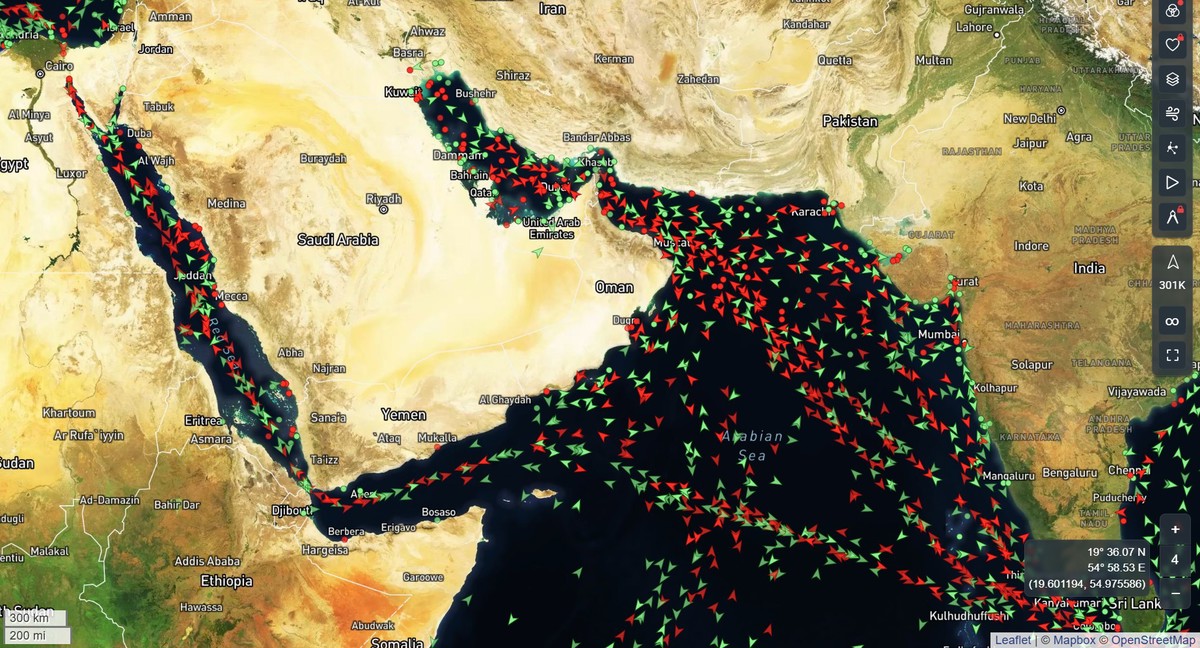
Those numbers matter for a simple reason: Europe does not need Hormuz to close completely in order to feel the damage. It is enough for markets to believe that the route has become riskier, because the response is immediate. Energy prices move, insurance costs rise, freight markets react, and uncertainty starts feeding into industrial planning long before any physical shortage appears.
That is why Hormuz should not be understood only as a transit route. It is also a pricing mechanism. The geography of the chokepoint gives it economic power because a threat to passage becomes a threat to expectations, contracts, and cost structures across the wider economy.
The Red Sea does not solve that vulnerability. It adds another layer to it. UNCTAD reported that attacks on shipping in the Red Sea drove a 42 percent fall in Suez Canal transits from peak levels, showing how quickly one of the world’s core east-west arteries can lose reliability.
Once that happens, the issue is no longer whether cargo can still move at all. It is whether it can move on time, at a manageable cost, and with enough predictability for businesses to plan around it. Ships can be rerouted around the Cape of Good Hope, but rerouting is not a free substitute. It means longer voyages, weaker schedule integrity, slower asset rotation, and more strain on already tight logistics systems.
Why Europe feels it quickly
Europe is unusually exposed to this kind of disruption because its economy depends on imported energy, imported inputs, and dense commercial links with Asia and the Middle East. A shock in Hormuz or the Red Sea does not stay in the Gulf or the Bab el-Mandeb. It moves through European industry, transport, prices, and confidence because Europe is deeply embedded in those long-distance networks.
This is where economic geography and business geography matter. Firms do not operate in the abstract. They are tied to supplier locations, production calendars, shipping corridors, delivery promises, and customer expectations. When a maritime corridor becomes unstable, that instability shows up inside the firm as delayed inputs, disrupted sequencing, weaker service performance, and pressure on margins.
The first hit is usually energy. If Hormuz becomes a risk premium in the oil and gas market, Europe feels it through fuel, petrochemicals, transport, and energy-intensive production. The second hit is freight. If the Red Sea becomes less reliable, shipping gets slower and more expensive. The third hit is timing. Once lead times stretch and arrival windows become less predictable, inventory planning becomes harder and operational efficiency starts to erode.
That burden is not shared equally. Large firms can sometimes absorb part of the shock through hedging, inventories, stronger contracts, and wider supplier networks. Smaller firms usually have less room to do that. They have less financial slack, weaker bargaining power, and fewer alternatives when routes become unstable. In practice, that means a chokepoint crisis often hurts SMEs, lower-margin sectors, and ordinary households faster than it hurts the biggest corporate players.
This is also why these disruptions quickly become political. Most people do not follow tanker routes or insurance premiums. They notice higher food prices, more expensive fuel, pricier imports, and another wave of inflation anxiety. By the time the public feels the shock, the mechanism behind it has already been at work for weeks.
The financial layer
There is another dimension that deserves far more attention: financial geography. These chokepoints matter not only because goods pass through them, but because risk is priced through them. Hormuz and the Red Sea are places where spatial disruption is rapidly translated into oil benchmarks, freight rates, insurance costs, and broader market volatility.
Financial transmission often moves faster than physical disruption. A factory in Europe may still be receiving supplies, but the firm is already facing higher input costs, tighter margins, more expensive transport, and greater uncertainty about what the next month will look like. That is why these crises are often first experienced as inflation, balance-sheet pressure, and planning instability rather than as empty shelves.
In that sense, chokepoints do not simply interrupt movement. They reshape the price of movement. And once that repricing begins, it spreads through the economy much more widely than the original map of the conflict might suggest.
Subsea geography & The cable story beneath the water
The least visible part of this picture may be the most revealing. In March 2024, damage to submarine cables in the Red Sea forced providers to reroute as much as 25 percent of traffic between Asia, Europe, and the Middle East. Later assessments showed that even where redundancy prevented total failure, cable incidents in this corridor could still worsen latency and degrade service quality.
This matters because modern supply chains are not managed only with ships and ports. They are managed through software, cloud services, financial systems, procurement platforms, communications tools, and real-time visibility networks. The same waters that carry tankers and container ships also carry the data that allows firms to organize production, monitor shipments, process transactions, and coordinate across continents.
That means Europe depends on this geography twice. It depends on it physically for goods and energy, and digitally for the information systems that keep trade functioning. A disruption at sea and a disruption on the seabed can therefore reinforce each other. One makes trade more expensive and less reliable. The other makes it harder to coordinate the response.
This is where the usual language of resilience becomes misleading. The fact that the internet remains “up” does not mean nothing serious has happened. Rerouting traffic may avoid collapse, but it can still create friction, delay, and degraded performance across business operations. In the same way, rerouting ships may avoid a total stoppage while still imposing major costs on firms and consumers.
A slower, more expensive Europe
The real danger, then, is not only a dramatic shutdown. It is a long period of degradation. Energy becomes more expensive. Shipping becomes less predictable. Data connectivity becomes less robust. Firms carry more precautionary stock, accept higher operating costs, and make decisions more defensively. Over time, that changes investment behavior, weakens margins, and chips away at Europe’s competitiveness.
This is what makes the Hormuz-Red Sea-cable nexus so important. It is not a single crisis in a distant region. It is a test of whether Europe has understood how modern vulnerability works. Today’s shocks do not stay inside neat policy boxes. They move from geopolitics into energy, from energy into freight, from freight into inflation, from cable damage into business coordination, and from all of that into the daily economics of life in Europe.
The lesson is straightforward. Europe can no longer treat energy security, maritime security, digital infrastructure, financial transmission, and supply-chain resilience as separate agendas. They now form one strategic field. And if policymakers continue to read oil, shipping, finance, and data as disconnected stories, they will keep underestimating how the next external shock is likely to arrive.
The warning from Hormuz and the Red Sea is not simply that the world economy still depends on narrow passages. It is that those passages now carry both the material and informational lifeblood of advanced economies, while markets transmit their instability faster than physical shortages can appear. For Europe, the next shock may not come as a single rupture. It may come as a tightening: higher costs, slower flows, weaker reliability, and a gradual loss of room to maneuver across the whole architecture of cross-border economic life.
